
A Complete Analysis of Waterproof Fabrics: From Principles to Processes, Understand Waterproof Ratings in One Go
 Foreword: How can a piece of fabric be made "not a drop of water leak-proof"?
Whether a jacket can truly keep out the rain depends not on how thick it looks, but on the technological logic behind the fabric. Waterproof fabrics are widely used in outdoor clothing, military training tactical equipment, mountaineering backpacks, tents, and footwear. The core of waterproof fabrics lies in how to build an effective "moisture barrier" on the surface of the fabric while maintaining breathability and a comfortable feel.
This article will start by discussing the three core processes, and then break down the true meaning of waterproof rating ( mmH₂O ) to help you build professional judgment.
1.Three Core Technologies of Waterproof Fabrics
1.1. High-Density Weaving
Principle: By using high-count yarns, extremely high warp and weft density is woven into a unit area, reducing the gaps between the yarns to less than the critical point of surface tension of a water droplet, thus preventing water from penetrating.
Key parameters:
- Yarn count is typically above 200D, with some high-end products reaching 400D–1000D.
- The fabric density (threads per inch) is much higher than that of ordinary fabrics.
- Common materials: Nylon, Polyester
Advantages: Soft to the touch, breathable, free of chemical coatings, and more environmentally friendly. Limitations: Relatively limited water pressure resistance; water may still seep in during prolonged heavy rain, usually requiring a Durable Water Repellent (DWR).
1.2. Coating Technology
Principle: A layer of high molecular polymer is coated on the surface of the fabric to fill the gaps between the yarns and form a continuous waterproof membrane.
Common coating materials:
| Coating type | characteristic | Typical applications |
| PU coating | Soft, resistant to low temperatures, and reasonably breathable. | Outdoor jackets, tents |
| PVC coating | Extremely waterproof and low cost | Raincoat, waterproof bag, car cover |
| PA coating | Stiff to the touch and inexpensive | Umbrellas, shopping bags |
| Silicone coating | Anti-aging and lightweight | High-end tents, paragliders |
Key points of the process: The coating weight (g/m²) directly determines the waterproof rating. The higher the weight, the greater the water pressure resistance, but the feel will be stiffer and the breathability will decrease.
1.3. Lamination technology
Principle: The process of bonding a functional film (such as PTFE, TPU, PU film) to the fabric with an adhesive under high temperature and pressure is the mainstream technology for high-end waterproof fabrics.
Core thin film type:
- ePTFE (expanded polytetrafluoroethylene) membrane: It has billions of micropores per square inch, with a pore size smaller than a water droplet but larger than a water vapor molecule, achieving both waterproofness and breathability. The representative technology is Gore-Tex.
- TPU thermoplastic polyurethane film: Excellent waterproof performance, good elasticity, and relatively low cost. It is often used in ski suits and diving material composites.
- PU hydrophilic membrane: It relies on the hydrophilic groups in the molecular chain to conduct water vapor. It has a non-porous structure and is more stable in waterproofing.
Common forms of bonding structures:
- 2-layer (2L): Fabric + membrane, with an inner mesh lining.
- 2.5 layers (2.5L): Fabric + Film + Protective Coating, the first choice for lightweight construction.
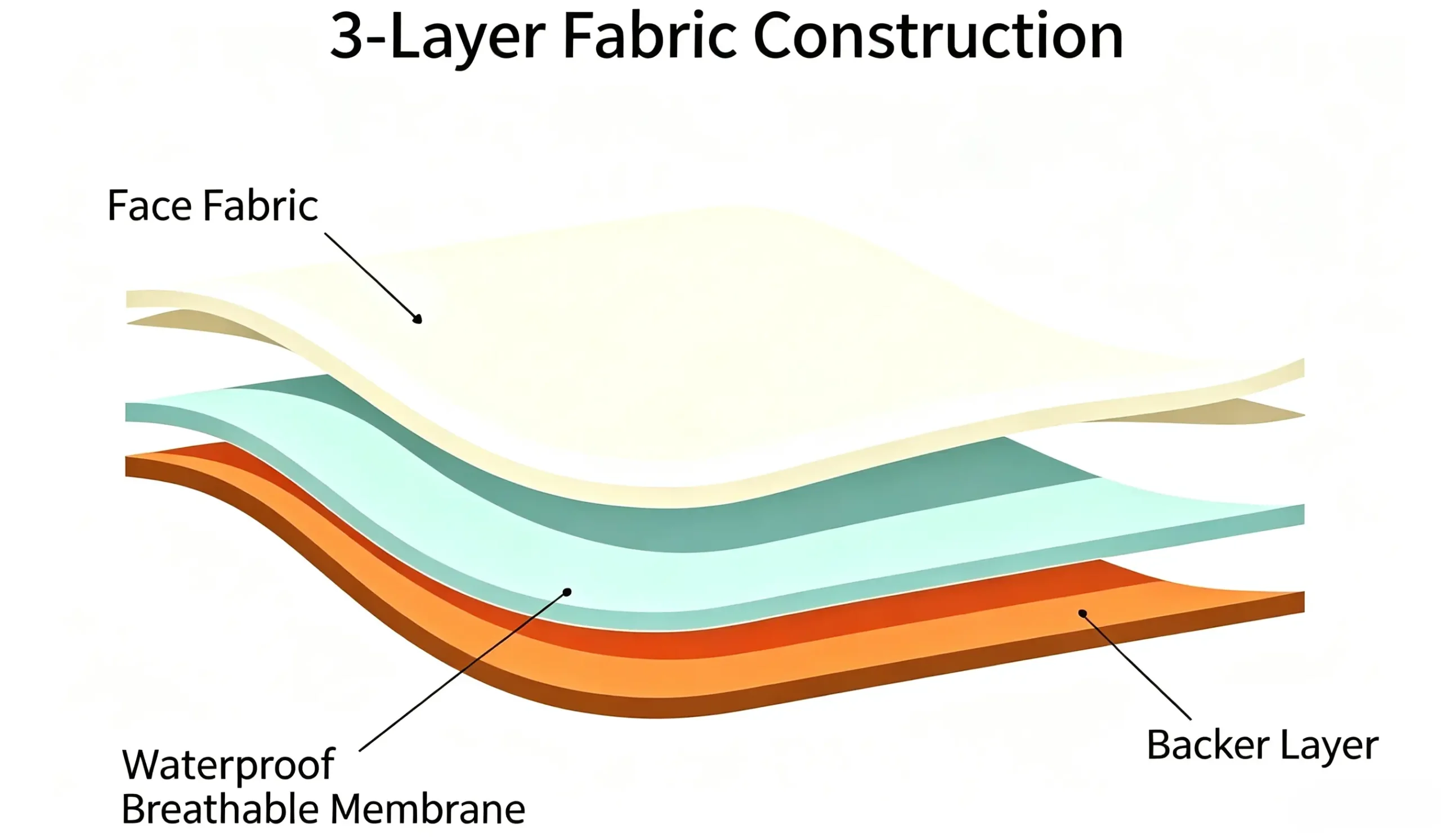
- 3-layer (3L): Outer fabric + membrane + inner lining fabric, most durable, suitable for extreme environments.
2. What exactly is the waterproof rating mmH₂O ?
definition
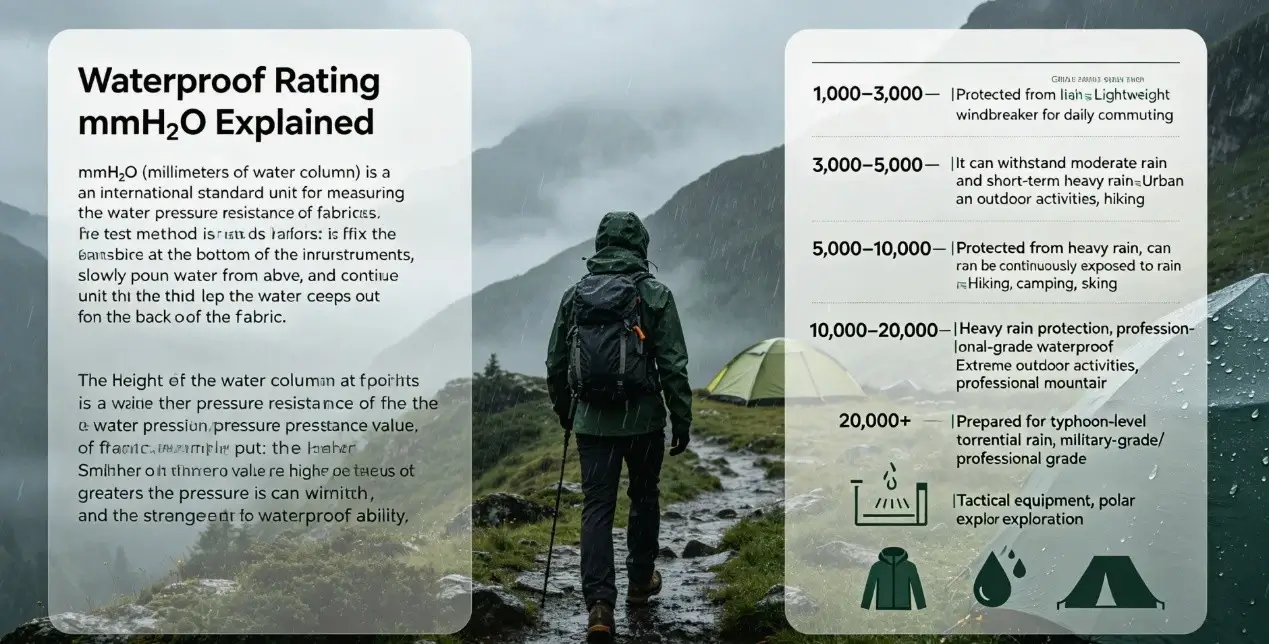
mmH₂O (millimeters of water column) is an international standard unit for measuring the water pressure resistance of fabrics. The test method is as follows: fix the fabric at the bottom of the instrument, slowly pour water from above, and continue until the third drop of water seeps out from the back of the fabric. The height of the water column at this point is the water pressure resistance value of the fabric.
Simply put: the higher the value, the greater the rain pressure it can withstand, and the stronger its waterproof ability.
Grade Comparison Table
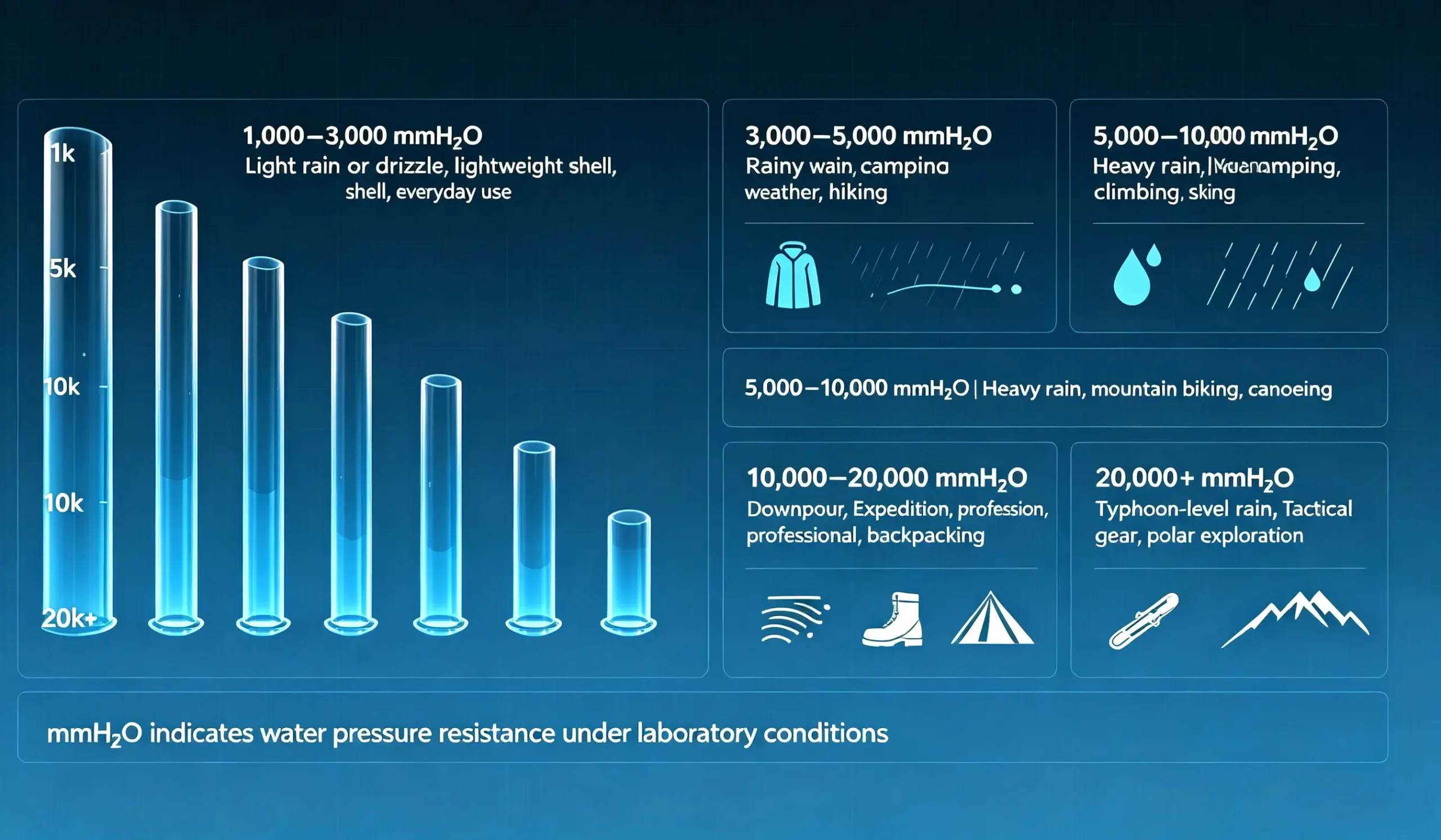
| Water pressure resistance ( mmH₂O ) | Waterproofing | Applicable Scenarios |
| 1,000–3,000 | Protected from light rain and splashes | Lightweight windbreaker for daily commuting |
| 3,000–5,000 | It can withstand moderate rain and short-term heavy rain. | Urban outdoor activities, hiking |
| 5,000–10,000 | Protected from heavy rain, can be continuously exposed to rain. | Hiking, camping, skiing |
| 10,000–20,000 | Heavy rain protection, professional-grade waterproof | Extreme outdoor activities, professional mountaineering |
| 20,000+ | Prepared for typhoon-level torrential rain, military-grade/professional grade. | Tactical equipment, polar exploration |
Three common misconceptions
Myth 1: The higher the value, the better? No. Higher water pressure resistance usually means lower breathability (g/m²/24h). For everyday use, 5,000–10,000 mmH₂O is sufficient; excessively high waterproof ratings can actually lead to stuffiness.
Myth 2: Water-repellent rating means no maintenance is needed? DWR (Durable Water Repellent Finish) will gradually lose its effectiveness with washing and wear, manifesting as the fabric surface "absorbing water and becoming damp" rather than "water droplets rolling off." At this point, the water-repellent rating is still present, but breathability will be significantly reduced, and it is recommended to reapply water-repellent agent regularly.
Myth 3: Seams don't need to be considered? Needle punctures will leave pinholes in the fabric, damaging the waterproof membrane. Professional waterproof clothing must have pressure-sealed waterproof tape at the seams; otherwise, the overall waterproof performance will be significantly reduced.
3. How to choose the right waterproof fabric?
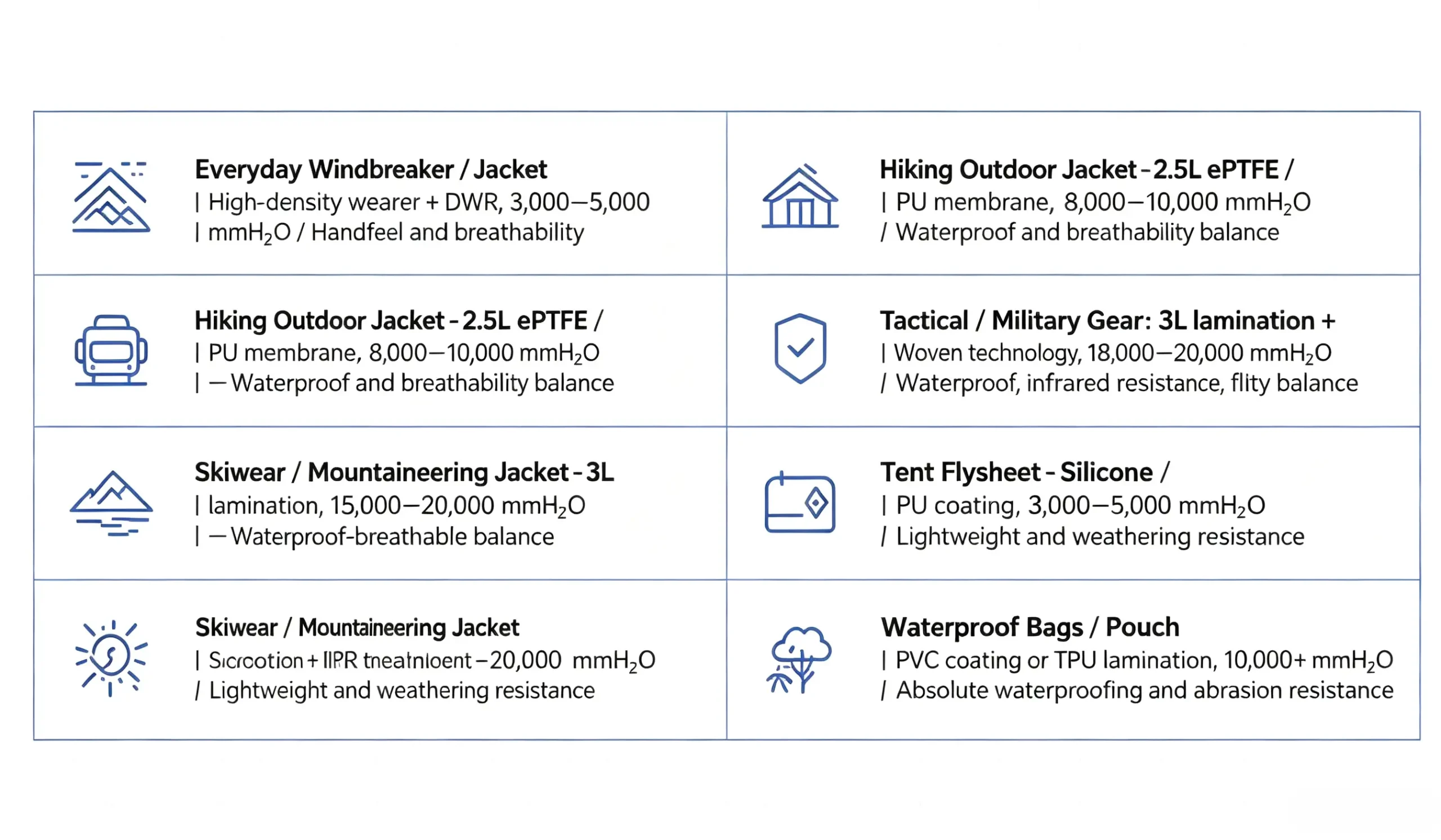
Recommended by usage scenario
| Application areas | Recommended process | Recommended water pressure resistance | Key Focus |
| Everyday trench coat/jacket | High-density weaving + DWR | 3,000–5,000 | feel and breathability |
| Outdoor hiking clothing | 2.5L lamination (ePTFE/PU film) | 8,000–10,000 | Waterproof and breathable balance |
| Ski suits/Mountaineering suits | 3L fit | 15,000–20,000 | Durability, fully glued |
| Tactical/Military-grade clothing | 3L bonding + IRR treatment | 20,000+ | Waterproof, infrared resistant, flame retardant |
| tent outer tent | Silicone/PU coating | 3,000–5,000 | Lightweight and resistant to aging |
| Waterproof bags | PVC coating or TPU lamination | 10,000+ | Absolutely waterproof and wear-resistant |
Four essential questions to ask during procurement
- What is the waterproof rating? What are the testing standards? (ISO 811 / AATCC 127)
- What is the air permeability? (g/m²/24h, recommended ≥ 5,000)
- Is it a coating or a lamination? What is the material of the film?
- Do you offer a seam sealing solution?
Conclusion
Choosing waterproof fabrics is never about "the more expensive the better," but rather about a precise match between the manufacturing process and the application scenario . By understanding the underlying differences between high-density weaving, coating, and bonding technologies, and by grasping the meaning and common misconceptions about mmH₂O, you can make professional judgments among numerous products.
Whether you're looking for a stable fabric supplier or need to develop a custom waterproofing solution for a specific product, feel free to contact Youvion ([email protected]) – we offer a full-chain service from raw material selection and process optimization to testing and certification, helping your products truly withstand the test of waterproofing performance.
